Videos are the heart of it.
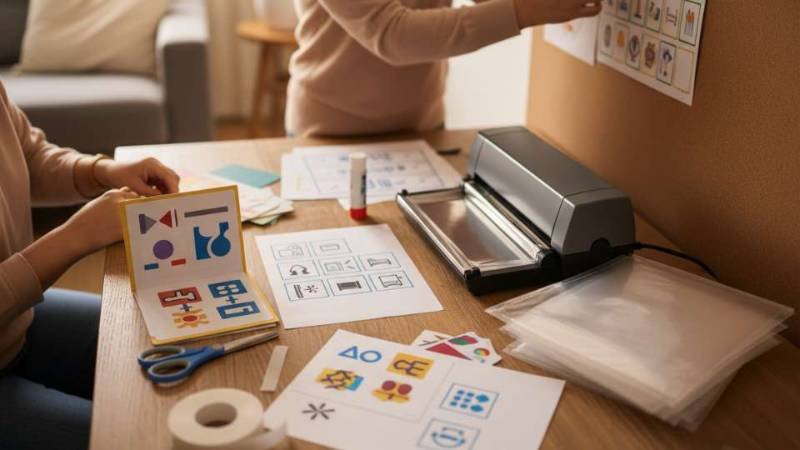
But the materials are the hands.
Because progress doesn't just happen when your child watches a video. It happens when what they learn sticks in real life : on the wall, in their routine, in the classroom, in the bathroom, in the park.
And that's where VICON's downloadable materials make a huge difference: they allow you to take the intervention home (and coordinate it with the school) in a practical, clear and sustainable way.
Why materials change the game
When a child has ASD or developmental/language difficulties, many crises don't stem from "bad behavior." They stem from:
- not understanding what's going to happen,
- unable to communicate what you need,
- feeling overwhelmed,
- or to live in a world that is too unpredictable.
Materials do something very simple and very powerful:
- uncertainty decreases ,
- comprehension increases ,
- and they offer alternatives .
That's regulation. That's learning.
What types of downloadable materials does VICON include?
(Depending on the level/block, you may find different formats.)
1) Cards
To work on vocabulary, requests, choices and functional communication.
Examples of use:
- “more” / “help” / “pause”
- choose between 2 options
- state what you want without getting frustrated
2) Sequences
To anticipate steps and reduce struggle in routines.
Examples:
- wash your hands
- get dressed
- collect
- morning/afternoon routine
3) Social stories
To prepare for difficult situations without forcing things in the moment.
Examples:
- go to the doctor
- birthday
- go to school
- wait your turn
4) Visual structures
To organize the day and reduce anxiety.
Examples:
- single schedule (4–6 blocks)
- “first / then”
- “now / later”
- Visual rules (few, clear)
How to use the materials at home (without becoming a therapist)
The key is not printing 200 pages. The key is choosing 2–3 materials and sticking with them.
Step 1: Choose a situation that is breaking you down today
For example:
- transitions (screen → food)
- bathroom
- leave home
- tantrums because they can't ask
Step 2: Put the material where life happens
- Sequence on the bathroom wall
- “First/Then” in the kitchen
- "Pause" card in the lounge
If the material is stored in a drawer, it doesn't exist.
Step 3: Teach it calmly (not in a crisis)
- 30 seconds a day
- You shape it
- You celebrate when he uses it
Golden rule: First learn in green. Then use in red.
How to use materials in the classroom (without asking for “a giant plan”)
If you want real coordination with the school, ask for micro-adjustments:
- 1. Visual structure (simple schedule)
- 1 support “first/then”
- 1 alternative communication option (card “help” or “pause”)
Useful phrase for tutoring: “I need it to not depend solely on words. With visual support and an alternative, anxiety decreases and participation increases.”
How they are used in therapy sessions (and why that benefits you)
In therapy, materials are not "cards." They are tools for:
- structure objectives,
- generalize skills,
- and teach you how to use them.
When the therapist teaches you how to adapt a material to your child, they are giving you back something enormous: autonomy .
Trial week: the perfect time to test materials
During the 7 days, don't try to do everything. Do this:
- Download 2 materials (one routine + one communication).
- Put them where you need them.
- Use them for 5 minutes a day.
- Observe: Is there less crying? Less fighting? More signs?
That's where you understand the difference: It's not a program. It's an ecosystem.
Quick checklist (to make it actually work)
- Choose 2–3 materials (not 20)
- I put them where the routine occurs.
- I taught them calmly
- I am reinforcing attempts (even if they are small)
- I am using “first/then” and alternatives
If you want to watch the videos and, above all, use downloadable materials to take the intervention home (with structure, anticipation and alternatives), you can try the VICON Method for 7 days free.