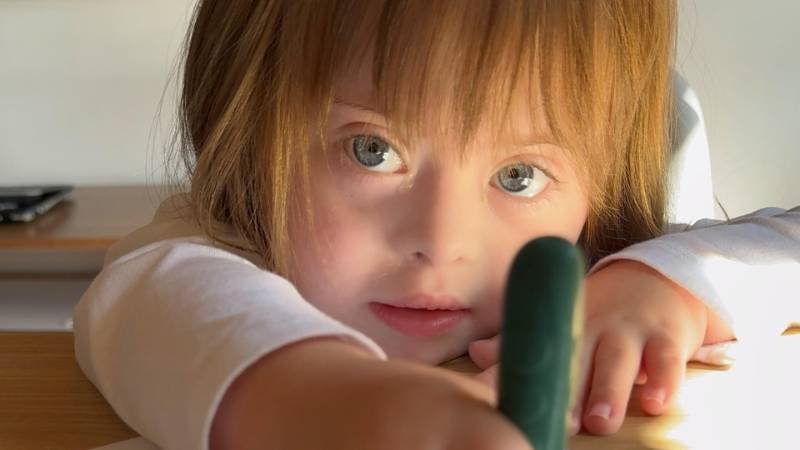
One of the biggest challenges many families with children with Down syndrome face is language development. It's common to hear phrases like, "My child understands everything, but he doesn't speak," or "We don't know how to help him communicate without getting frustrated."
And amidst these doubts, a key question arises: Should we use sign language if our child doesn't speak? The short answer is yes. And we'll explain why.
Language is not just speaking
Before their first words appear, children are already communicating. Through their eyes, gestures, sounds... and, in many cases, through signs or pictograms.
In children with Down syndrome, oral language development is often delayed due to factors such as hypotonia, hearing difficulties, or neurological immaturity. Therefore, offering them alternatives for visual communication not only does not delay speech, but actually facilitates its development.
Benefits of sign language in children with Down syndrome
Using signs in early stages or when oral language is limited has great advantages:
- 🔊 Reduces frustration by allowing the child to express wants and needs.
- 🧠 Improves oral language comprehension by reinforcing the message visually.
- ✌️ It fosters communicative intent, one of the pillars of language appreciation.
- 🧳 Stimulates memory and joint attention, thanks to the association between word and gesture.
Does using sign language delay speech?
This is one of the most common fears, but it's not supported by evidence. Several studies in music therapy, neuroeducation, and therapeutic pedagogy show that children who use sign language from an early age develop more vocabulary and often begin to speak with greater confidence.
Sign language does not replace speech: it accompanies it, reinforces it, and acts as a bridge to it.
Activities to begin using signs at home or in the classroom
If you want to get started, here are some simple strategies:
1. Basic everyday signs
Start with function words: more, eat, water, sleep, no, bathroom. Use the sign whenever you say the word out loud, calmly, and with eye contact.
2. Sing with signs
Rhythm helps cement meaning. You can use nursery rhymes and introduce signs to key parts of the lyrics.
3. Stories or pictograms with gestural support
Choose simple stories and accompany them with signs. This reinforces listening and visual comprehension.
4. Imitation games
Invite your child to mirror your gestures. It's a fun way to introduce new signs.
And how do we do it in the VICON Method?
At the VICON Method, we work on language development in children with Down syndrome through interactive music videos, where each song includes:
- Adapted sign language to reinforce understanding.
- Function words repeated in different contexts.
- Video modeling with real children, which allows the child to identify everyday actions.
- Music therapy strategies that activate auditory memory, imitation, and joint attention.
All this, with an easy-to-follow structure that you can repeat at home or in the classroom.
Conclusion
Using sign language with children with Down syndrome is not a temporary measure or a crutch. It's a powerful, accessible, and natural tool that allows them to communicate from the very beginning and builds a bridge to oral language.
If your child doesn't speak yet, giving them a way to communicate now is the first step toward getting them started tomorrow.
In this process, having structured tools can make all the difference. The VICON Method offers you a clear, musical, and multisensory way to incorporate sign language, video modeling, and language stimulation into your daily life. The best part is that you can do it from home and at your own pace.
If your child doesn't speak yet, giving them a way to communicate now is the first step toward getting them started tomorrow.
⭐️ Have you used sign language with your little one? Tell us about your experience or leave your questions in the comments! Your story may help other families on the same path.




One Response
Soy Vronica tengo un alumno autista que el cuesta mucho salir de casa, he empezado a trabajar las rutinas de la mañana mediante un cuento: imagenes claras, sencillas de un animal porque no he encontrado ningún cuento con personajes de niños reales como habeis comentado.
El niño muestra interés y participa mientras miramos el cuento. La pena es que no podemos trabajarlo muy seguido por sus faltas al centro, también le hemos preparado material para casa un horario con pictogramas de las cosas que se hacen en el centro y le gustan. Para poder motivarle por las mañanas.
Gracias.