There's a phrase that really hurts: "They treat everyone else well... except me." And it usually comes with guilt, exhaustion, and a silent question: "What am I doing wrong?"
The answer (though it won't alleviate your exhaustion) may bring you some relief: often your child doesn't behave worse towards you because they respect you less. They behave worse towards you because they feel safe with you.
That's called decompression: endure it outside (school, therapy, the street) and collapse where you can let go. It's not manipulation. It's physiology.
But be careful: safety is not permissiveness. Boundaries are also a form of connection. The key is learning to maintain both: calm + boundaries + repair.
Why it happens: the “decompression” theory
Many children spend the day making a huge effort:
- sustain attention
- inhibit impulses
- tolerate noise and demands
- understand language quickly
- adapt to changes
When they get home, their body says, "I can't take it anymore." And it explodes with the person they trust the most.
Typical signs that it is not “misconduct”, but deregulation
- It gets worse when I get home
- It gets worse before bedtime
- It gets worse when you cut the screen
- It worsens with hunger or sleepiness
- It gets worse with changes in plans
- It gets worse when there's a lot of talking or questions
If it happens repeatedly at those times, you're not dealing with "a bad child." You're dealing with an overwhelmed nervous system.
What usually makes things worse (unintentionally)
When we're tired, we do what we can. But there are three things that usually add fuel to the fire:
- Talking too much in a crisis
- Ask "Why are you doing this?"
- Trying to reason with a child when they are outside the window of tolerance
In a crisis, language doesn't come into play. In a crisis, regulation comes first.
VICON protocol in crisis: 4 steps
1) Low demand (fewer words, more presence)
- You get closer, lower your tone, shorten your sentences.
- One slogan, or none.
2) Short and clear limit
- “I don’t stick.”
- “I don’t bite.”
- “I don’t break.”
No speech. No sermon.
3) Regulatory alternative: The limit goes with an exit:
- “Squeeze the ball.”
- “Breathe with me.”
- “Come on, wall.” (pressure)
- "Water." (if it helps)
4) Real pause. You wait. You don't fill. You don't negotiate. You hold.
After the crisis: repair in 3 sentences
When it's over (even if it's 10 minutes later):
- “It was difficult.”
- “I’m with you.”
- “Next time, we’ll do (an alternative).”
He doesn't need to ask for a perfect apology. The relationship needs to be repaired.
Cold rehearsal (30 seconds) so that tomorrow is different
In a quiet moment, you practice the script:
- You: “Screen saves.”
- He: (slight protest)
- You: “It’s difficult. I’m with you. Ball.”
Rehearsing without a crisis creates pathways. In a crisis, the brain uses pathways.
Prevention: the “arrival home kit”
If the critical moment is arrival, try this for 7 days:
- 10 minutes of low demand (zero questions)
- Snack/water (low hunger tolerance)
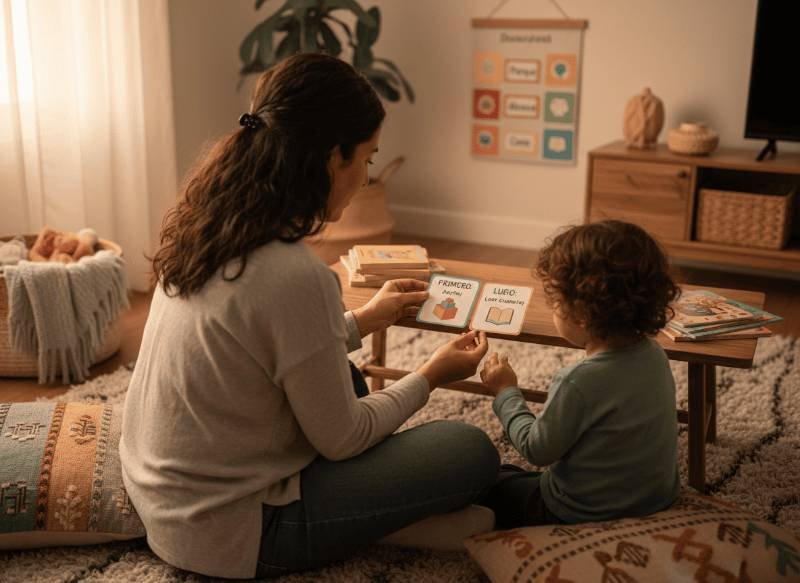
- “First/then” visual routine
- A short regulatory activity (music, pressure, movement)
It's not about giving in. It's about preventing collapse.
Typical mistakes (and how to correct them)
- Mistake: asking for explanations in the middle of a crisis.
- Change: repair later, regulate first.
- Error: long punishments when the child is dysregulated.
- Change: short limit + alternative.
- Error: arguing about the limit.
- Change: ritual + script repetition.
7-day mini plan
- Day 1: Identify the most critical moment.
- Day 2: Reduce words at that time.
- Day 3: Define 1 short limit + 1 regulatory alternative.
- Day 4: Create a transition ritual (timer/first-then).
- Day 5: Rehearse cold for 30 seconds.
- Day 6: Record intensity/duration (not perfection).
- Day 7: Adjust: What lowered the crisis by 10%?
Checklist
- Fewer words in crisis
- Short limit
- Regulatory alternative
- Real pause
- Repair in 3 sentences
- Cold test
- Visual routine for transitions
Frequently Asked Questions
So, do I have to let him do whatever he wants because it's deregulated? No. Regulation is not permissiveness. The limit remains, but it's maintained calmly and with a way out.
What if he behaves worse with me, but not with his father? It could be due to roles, schedules, accumulated fatigue, or who has more demands. It's not a competition: it's about information.
What do I do if I explode too? First: repair the damage. An adult who repairs the damage teaches more than a perfect adult. And if you can, prepare short phrases for when you're at your limit.
Does this work for children with limited language? Yes. In fact, the less language they have, the more important it is to reduce demands and use visual supports and routines.
Download the VICON Method App and try it for 7 days free with therapeutic support.
Android: https://play.google.com/store/apps/details?id=com.metodovicon.app