Your child hits. Bites. Yells. Throws things.
And you're left with a mixture of fear, guilt, and exhaustion.
Because a part of you thinks, "What if it gets out of hand?"
And another group is fed up with hearing: "Set boundaries" as if that were a technique.
Let me be clear: many behaviors that seem "challenging" are a nervous system in the red .
It doesn't mean "anything goes." It means that if you want to reduce the intensity, you need to stop putting out fires with punishments and start working with principles.
Here are 5.
Before the 5 principles: an idea that changes everything
Behavior doesn't appear out of nowhere.
It appears when the child:
- He cannot communicate what he needs,
- He doesn't understand what's going to happen.
- is sensorially saturated,
- Or he's asking for control because inside he feels out of control.
If you only look at behavior, you're too late.
If you look at what causes it, you'll arrive in time.
1) Behavior is communication
No, your child is not "being bad".
He is saying something with his body because he cannot say it with words (or because words are not enough for him at that moment).
Frequent translations (to make it clearer)
- Pega: “Get out of my way / you’re invading my space / I don’t know how to ask for space.”
- Bite: “I’m at my limit / I need to release.”
- She shouts: “This overwhelms me / I don’t understand / I can’t take it anymore.”
- She throws things away: “I need control / I need to stop.”
Key question (before correcting):
- "What are you trying to say?"
2) Anticipation: if you know it's coming, you get ahead of it.
Many crises are predictable.
Not because the child "chooses" to have them, but because there are repeated triggers:
- transitions (leaving the park, turning off the screen, going to take a bath)
- wait
- hunger / sleep
- noisy places
- unstructured tasks
Anticipation reduces anxiety.
Simple (and powerful) examples:
- “We’ll be finished in 5 minutes.”
- “First shoes, then car.”
- “When we arrive, we go to the bathroom.”
If your child uses visual aids, even better:
- visual countdown
- 3-step schedule
- “first / then”
3) Offer alternatives (otherwise, the default behavior wins)
If the child has no other tool, he will use the one that works: behavior.
Your job is to show him a safer way out.
Alternatives depending on need:
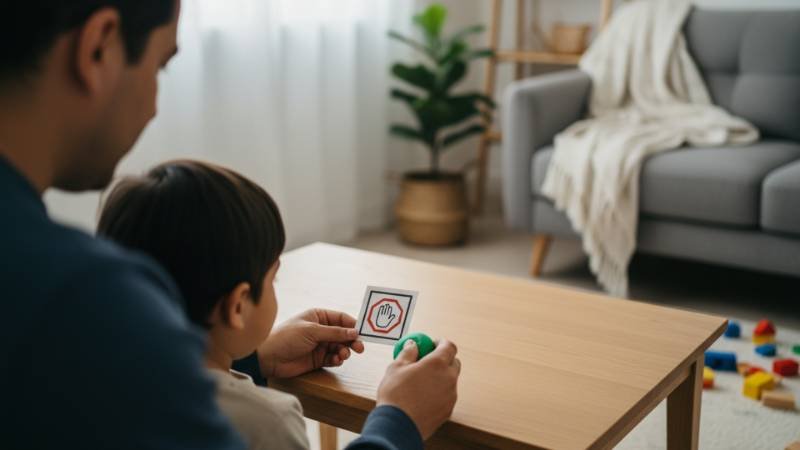
- To ask for space: point to “pause”, sign “I need a break”, gesture to “stop”.
- To relieve tension: squeeze a ball, push against a wall, breathe with bubbles.
- To choose without entering into a fight: “A or B?” (limited choice).
- To ask for help: gesture, pictogram, keyword (“help”).
Golden rule:
- Don't wait for a crisis to teach it. Practice it calmly.
4) Stay calm (your calm is its regulation)
When you yell, the child doesn't "understand the limit".
He gets scared.
And when he gets scared, he becomes more deregulated.
This is not “being soft”.
This is understanding co-regulation.
Mini script for the red moment:
- lower the volume
- In a few words
- stable posture
- safe distance
- A short, repeatable phrase: “I’m here. I’ll help you.”
And yes: sometimes you're trembling inside.
But on the outside, you are the ground.
5) It's not personal (it's a nervous system in red)
This principle saves you.
Because when you take it personally, you go to war.
And when you go to war, the behavior escalates.
Your son is not saying:
- “I want to hurt you.”
He is often saying:
- “I can’t handle this.”
Key perspective:
- The goal isn't to win. The goal is to get back to green.
72-hour mini plan (to get started without going crazy)
Choose ONE behavior (only one) and work with it:
- Record 3 moments (without judgment):
- When does it happen?
- What happened just before?
- What did the behavior achieve?
- Add 1 anticipation at that time.
- Add 1 alternative (gesture/pict/object) and practice it calmly.
- Strengthen the small things :
- If he asked for a break without shouting, that counts.
- If it stopped for 2 seconds, that counts.
Constancy > perfection.
Quick checklist (to save)
- I'm looking for the message behind the behavior
- I am anticipating transitions
- My son has a concrete alternative.
- I lower the volume and use few words
- Remember: it's not personal, it's regulation.
If you want step-by-step tools to work on attention, imitation, communication and language (which are usually the basis for reducing many behaviors), you can try the VICON Method for 7 days free.