Your child is in crisis. Screaming. Crying. Out of control. And your heart is racing, thinking: "What do I do now?"
Here's an uncomfortable but liberating truth: in a meltdown, your child doesn't need a lecture. They need regulation.
It doesn't mean "anything goes". It means we first go back to green... and then we teach.
This article offers four practical strategies to use at home during crises (in children with ASD and developmental/language difficulties). They are simple, but effective when applied intentionally.
Before we begin: what is a crisis (in simple language)
A crisis is not "bad behavior." It is usually a nervous system overwhelmed by:
- unexpected changes
- frustration
- sensory overload
- tiredness / hunger
- difficulty communicating
If you try to "win" at that moment, the intensity increases. If you regulate, the intensity decreases.
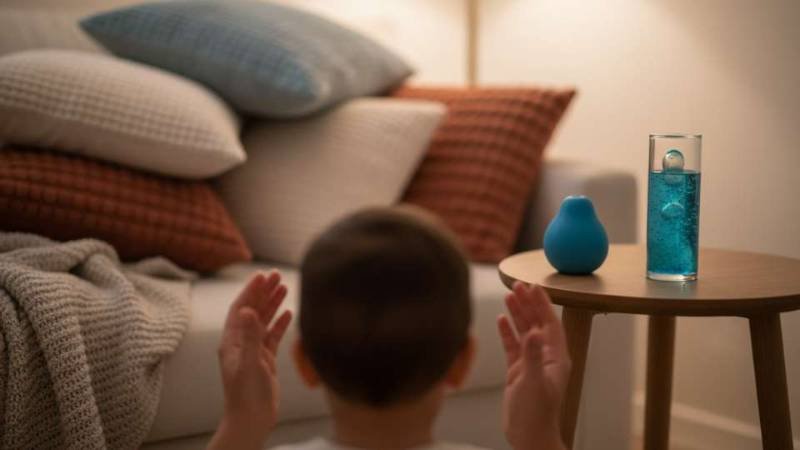
Strategy 1) Safe space (not punishment)
A safe space is a place where your body can unwind. It's not "go to your room for misbehaving." It's: "let's go to a place that helps your brain return to normal."
As it should be
- don't worry
- low light
- few stimuli
- ideally always the same
It could be a room, a corner with cushions, a tent, a rug.
What to say (short script)
- “Let’s go to the safe space.”
- "I'm here."
- “When your body is ready, we’ll be back.”
Strategy 2) Movement (to release tension)
Many children regulate their emotions through movement. In times of crisis, the body is full of "stuck" energy. Movement releases it.
Quick ideas (5 minutes)
- jump in place
- run down the hallway
- dance to soft music
- push the wall (yes, push)
- carry something “heavy” (books, a small box)
Practical rule: 5 minutes of guided movement is better than 30 minutes of fighting.
Strategy 3) Deep pressure (safety for the nervous system)
Deep pressure is a sensory tool that many children tolerate very well. The brain interprets pressure as safety.
Options
- firm hug (if the child accepts it)
- wrap in a "burrito" style blanket
- gentle pressure on shoulders/back
- weighted cushion or weighted blanket (if you use one and it's recommended)
Important:
- never force
- always look for “yes” or “no” signs
Signs that it helps: the body relaxes, the scream subsides, and eye contact appears.
Strategy 4) Breathing (your calm is contagious)
In a crisis, asking to "breathe" might sound like a joke. But if you do it and model it, the child's body can copy it.
Simple guided breathing
- “Inhale through your nose.”
- “Exhale through your mouth.”
Do it slowly. With few words. With your body as an example.
Tip: If your child is small, use a support:
- blow bubbles
- blow a feather
- blow out an imaginary candle
How to choose which one to use (without going crazy)
You don't have to use all 4 at once. Choose based on what you see:
- Too much noise/stimulation → safe space
- Lots of energy/momentum → movement
- High body tension → deep pressure
- Lots of emotional escalation → breathing (modeled by you)
After the crisis: what helps (and what doesn't)
When the child turns green again:
Yes, it helps.
- To describe what happened in a simple phrase: “It was difficult.”
- Teach an alternative for next time: “When you need to stop, we pause.”
- Reinforce any attempt at regulation: “You’re back. That counts.”
It doesn't help.
- long sermons
- questions like “why did you do it?”
- punishments that only add to fear
Mini 7-day plan (to make a difference)
For one week, prepare this at home:
- Define your safe space (and use it calmly too).
- Choose 2 movement options that your child can tolerate.
- Test 1 form of deep pressure (only if it accepts it).
- Practice breathing for 30 seconds a day when you feel well.
The regulation is trained in green so that it can be used in red.
Quick checklist
- I have a defined safe space
- I know which movement regulates it
- I have a deep pressure option (if you accept it)
- I lower the volume and use few words
- Remember: first we return to green, then we teach
If you want step-by-step tools to work on attention, imitation, communication and language (foundations that greatly help to reduce crises and increase cooperation), you can try the VICON Method for 7 days free.