In order to fully understand what Autism really is and what it means to live with a person with this spectrum, we are going to present to you different key points of the life process in which families can find themselves... Let's get to it!
The expectations:
When you have a child you ask yourself a thousand questions and mental plans about what they will be like, what you will do and what their future will be like . We always think that our children are going to go much further than we have gone, that they will overcome obstacles in their lives and that we will be by their side to help them. These and a thousand other similar thoughts pass through our minds.
After the initial fuss, you see how your child grows, and his development is observed with a magnifying glass . Any small gesture, any progress , no matter how minuscule it may seem, is analyzed exhaustively .
And then you discover that this development is something different , that not everything is as you expected, or as you had been told, or as you read in that great encyclopedia for new parents. Something inside you tells you that something is not right . And at first you don't give it much importance, but there comes a time when you tell yourself: This is not normal, something is happening here.
Strange behaviors:
Your child is not behaving as expected , something happened at a certain time. Every day there are 3 types of manifestation of autism : born, made and converted . And your child begins to exhibit a long list of strange behaviors, unforeseen behaviors:
- Tiene risas espontáneas, que no parecen tener relación con nada.
- Se pasa el día aleteando con sus manitas, se balancea, realiza movimientos repetitivos frecuentemente.
- No parece interactuar socialmente con nadie, ni siquiera te mira a los ojos.
- Le llamas, pero no te atiende, ni se gira. ¿Será sordo? Piensas. No, porque oír si oye, ya que algunos sonidos lo ponen muy nervioso.
- Es muy torpe y se cae continuamente, pero no llora. O llora muy poco, y cuando llora, presenta un llanto inconsolable que no parece tener relación con nada.
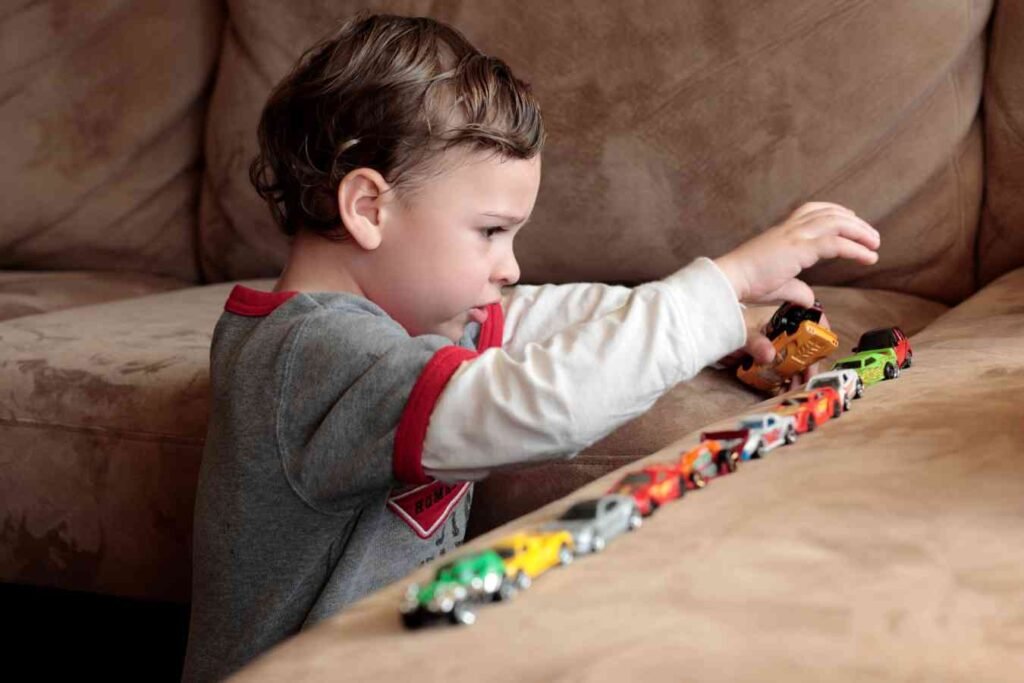
- He uses his toys in a strange way, stacks them, aligns them, sorts them by shapes, colors... He doesn't know how to use toys.
- Si le das un coche, se sienta en el suelo y puede estar un largo tiempo dándole vueltas a la rueda, y mirando fijamente cómo gira la rueda. Realmente, las cosas que giran lo dejan extasiado.
- Sus balbuceos desaparecen de golpe, ya no dice nada, incluso las cosas que antes decía, ya no las dice.
- Cuando quiere algo, usa tu mano como una extensión.
- If you point at something, simply look at your finger, and not where you're pointing.
- Cuando le abrazas presenta un rechazo.
- Parece que la ropa le moleste toda.
- De forma repentina la hora de la comida se ha convertido en un drama. Conseguir que coma es todo un reto.
We feel that these types of behaviors or several of them clearly fall outside of normal development and logically alert us . They come to confirm something that deep down we already assumed. Something is happening to our son .
But sometimes the pediatrician tells us that he is in perfect health, that his physical development is above average, but in reality something is wrong with my son.
And meanwhile your family, friends or acquaintances tell you that each child is different , that the son of a cousin in the town did not speak until he was 5 years old and that these are normal things, etc. Basically everyone is clear that absolutely nothing is wrong with your child, and everyone seems to know an incredible number of cases of children who apparently had the same thing happening to yours and today, curiously, they are all people with outstanding lives. And Wow, they don't convince us! And since you are absolutely convinced that something is not right, you begin a long journey in search of answers.
The way:
Ante las conductas extrañas se inicia un recorrido largo y agotador a la búsqueda de respuestas.
The pediatric :
As we said, unless you are lucky enough that your child's pediatrician has knowledge about neurodevelopmental disorders, the most normal thing is that he or she will simply give you the slip and think that he or she is facing another hysterical mother . « He'll talk, take him to daycare, each child has a different process... » etc, and when you are telling them about the strange behaviors they look at you with a certain condescending and skeptical air but they don't seem to have any intention of doing anything. In the end, and after much insistence and managing to convey some concern to the pediatrician, you manage to be referred to the neuropediatrics service. But you leave the pediatrician's office with some uneasiness, since you have had to adopt an extremely forceful stance to get them to listen to you, and once again you are assailed by doubts as to whether nothing is really wrong with the child and you are really a hysterical mother who sees things where there are none.
Referral to Neuropediatrics :
After an indeterminate amount of time, especially if you use the public health system, you end up visiting a neuropediatrician. This new professional is supposed to know about this aspect. If you are lucky and find a very good professional, they will not only give credence to your concerns, they will get to work. And here comes the next problem.
Medical tests :
The child must have an MRI, Evoked Potential test, Karyotype Analysis,... And for some reason all these tests are very traumatic, the child must be sedated and blood drawn at just 2 years old. And all this, in turn, generates a degree of guilt in you, a great uncertainty, you ask yourself questions like: What if everyone else is right and I am wrong, why have I put my son through all these? martyrdoms?
Internet
Y para añadir algo más de tensión, te lanzas a buscar información, pero con preguntas que no siempre obtienen las respuestas adecuadas. Bien, hoy es algo más fácil, ya que el volumen de información relativa al autismo se ha multiplicado de forma exponencial en estos últimos años, pero a veces piensas si no es para peor. Ya que el que exista mucha información no significa que esta información sea buena, de hecho podemos encontrar auténticas barbaridades.
The diagnosis, an emotional blow:
After a long journey, searching for no one knows exactly what, the diagnosis finally arrives. They initially cover it with a euphemism called Pervasive Developmental Disorder (PDD) , which is a pretty bad definition, since the name itself is a bit of a misnomer. Although they tell you, trying to be as delicate as possible, that in reality what your child has is called Autism . And quickly the ground collapses at your feet.
Por supuesto la información suministrada a los padres no cumple con las necesidades mínimas. Y básicamente te dan una información bastante breve, que te puedes incluir en el plan de atención temprana, que en su momento consistía en 45 minutos a la semana, y que hoy ha aumentado a la increíble cantidad de una hora y media semanales. Aunque tampoco te explican bien qué es eso de la intervención Temprana.
- La vuelta a casa. Pero uno de los mayores problemas es que te vas a casa con un diagnóstico que no sabes exactamente qué es, pero que el nombre da pánico. Sales con menos información de la que entraste. Y cuando regresas a casa inicias una búsqueda frenética de información, y si cuando te dieron el diagnóstico te quedaste en shock, cuando empiezas a leer te quedas helada.
- Family support is usually not of quality . There is usually no valid family support model, no one informs you adequately, it takes forever to be able to sit down with other parents, who then each experience it differently. And as a result of this blow you enter a very difficult and complicated emotional state, and after a while (again late) someone tells you that it is called the grieving process... Does my son have autism? And what is that?
The duel:
This process can be very complex and of indeterminate duration. Furthermore, the couple tends to live at different speeds, which certainly doesn't help at all.
The phases of grief can be summarized in five large blocks , and although some people may even skip some phases or have extremely short grieving, in the end in one way or another we all go through this painful process. Are:
5.1. The negation
En la primera fase lo normal es negar lo que acontece. Es un sistema de autodefensa emocional . Pensar que todos están equivocados, mi hijo no puede tener Autismo, eso es algo horrible, tiene otra cosa seguro y encontraré la solución. A continuación vienen familiares y allegados a dar su opinión, realmente ellos aun saben menos que nosotros sobre autismo, pero cómo dar opiniones es fácil pues la dan. Y por alguna razón volvemos a las típicas historias que en su día ya nos habían contado, que si el hijo de fulanita esto, que si el hijo de menganita lo otro. Que antes esto no pasaba porque se educaba bien a los niños (que es una forma sutil de echarnos la culpa), que sí deberías hacer esto o lo otro. Toda esa cantidad de consejos diversos, que no tienen excesivo sustento, acaban por generarnos una mayor incertidumbre.
5.2. The Rebellion
After the first phase, we made the decision to prove that everyone is wrong and that we are going to find the solution. We enter a kind of obsessive phase , where we start reading and reading and we really end up becoming intoxicated with information. The greatest danger of this moment is to end up hearing someone say what you want to hear. Here you start to receive people with some great videos of children who have been cured, of all kinds of systems to leave your new child. And from vaccines to food, they end up being to blame for what happens to your child. And this is what you wanted to hear, that autism is reversible.
Luego piensas que si esto es así, ¿por qué no les han dado el Nobel de medicina? Y si son protocolos experimentales, ¿por qué tengo que pagar? Mi hijo no es una cobaya. Y luego ves que todo eso es un fraude y empiezas a cuestionarte todo de nuevo, tu vida incluida. Y mientras te cuestionas todo, nuevos miedos te asaltan. ¿Cuál será el futuro de mi hijo? ¿Quién cuidará de él? Y ante estas y otras mil preguntas nuevamente reniegas de todo y crees que al final todo irá bien, que algo sucederá y te despertarás de esa especie de pesadilla en la que vives.
5.3. The blame
It's your fault ◦It's everyone else's fault ◦It's the doctor's fault
Couple crises and the different speeds of grief begin. But you never wake up from that nightmare, so the process of searching for the culprit begins. And this is a very delicate phase, where the strength of the couple is tested, and the first person we blame is precisely our partner. That way, if it's your fault, I have some relief. Next we look for another culprit, and we return again to the bizarre theories, that it was a vaccine, that it was your family's fault...
Superadas las culpas familiares, la culpa es del médico, en el momento del parto algo hicieron mal y por eso el niño está así. Y en este momento delicado es donde más se aprecian las diferentes velocidades del duelo. Incluso que la forma de afrontarlo de la mujer suele ser muy diferente a la del hombre. O las explicaciones sobre los por qués. Esto puede ser un proceso muy peligroso. Que no lleva a ninguna parte y que además es contraproducente.
5.4. The Depression
After all these previous processes, we enter depression, caused by emotional saturation , by exhaustion at all levels. Again, you look for answers, those that until that moment either no one gave you or you didn't want to hear. And reality comes back harsh and insistent to tell you that this is what it is. Finally you have no choice but to accept reality : my son has autism . And the pain that assaults you hurts so much that it is very difficult to bear it. While your heart shakes you see your son, and you realize that your love for him is unconditional, that no matter what happens you will be by his side. And you know that the road is going to be long and difficult.
5.5. The acceptation
Once reality is recognized and accepted, we begin a different process. Although the pain persists, we know that we cannot allow ourselves to be overcome by it and we begin to try to calmly understand autism itself. And you realize that in the entire previous process, you learned a lot, but you were not able to realize it. You have to plan for the future, and you have to do it now. And in order to do so we must be able to understand not only Autism itself, but our own child . Understanding their capabilities, their shortcomings, their needs, and a long list of things will help us decide what we should do, but from a place of serenity and acceptance.
The progress
Throughout this long process we have learned that each child is unique , that they have different needs, that have nothing to do with the children of other families. We have discovered the importance of communication, without it it is very difficult to move forward. Understanding what the child needs is vital to adapt the intervention. To work on their shortcomings and enhance their capabilities.
We have understood that if there is no stability at home, the child will not have stability. We have learned to live with a child who is neither better nor worse, he is simply different from what we had thought.
Learning to live again
To finish this first entry we want a special story: "The Trip to Holland" by Emily Pearl.
Ella es la madre de un niño con Síndrome de Down que escribió un cuento maravilloso sobre la llegada de un niño diferente, y usó una bella metáfora.
When you're having a baby, it's like planning a wonderful vacation trip to Italy. You buy a lot of travel guides and make wonderful plans: the Colosseum, Michelangelo's David, the gondolas of Venice... You even learn some useful phrases in Italian. It's all very exciting. After months of waiting with excitement, the day finally arrives. You pack your bags and go on your trip. A few hours later, the plane lands. The stewardess comes and tells you:
Welcome to Holland
Holland? - you say -. What do you mean by Holland? I booked a trip to Italy! It should be in Italy! All my life I have dreamed of going to Italy. But there has been a change in the flight plan. They have landed in Holland and you have to stay there.
The most important thing is that you have not been taken to a horrible, unpleasant place, full of bad smells, hunger and diseases. It's just a different place. Therefore, you have to go out and buy yourself new travel guides. You must learn a completely new language. And you will meet a whole group of new people you would never have met before. It's just a different place. It is calmer than Italy, less exciting than Italy.
After spending some time there and catching your breath, you look around... and you start to realize that Holland has windmills... Holland has tulips. Holland even has Rembrandts. But everyone you know is busy going back and forth to Italy… and they're all bragging about what a great time they had there. And for the rest of your life, you'll say to yourself: Yes, that's where I should have gone. That's what I had planned. And that pain will never go away, because the loss of that dream is a very, very significant loss. But… if you waste your life regretting not having gone to Italy, you will never be free to enjoy the special and wonderful things that Holland has to offer.
We promise you a second installment where we will delve more into what it really means to live with Autism.
Meanwhile, as always, we invite you to follow us through our social networks, such as ourFacebook group made up of many families who are in the same situation as you... You are not alone families!