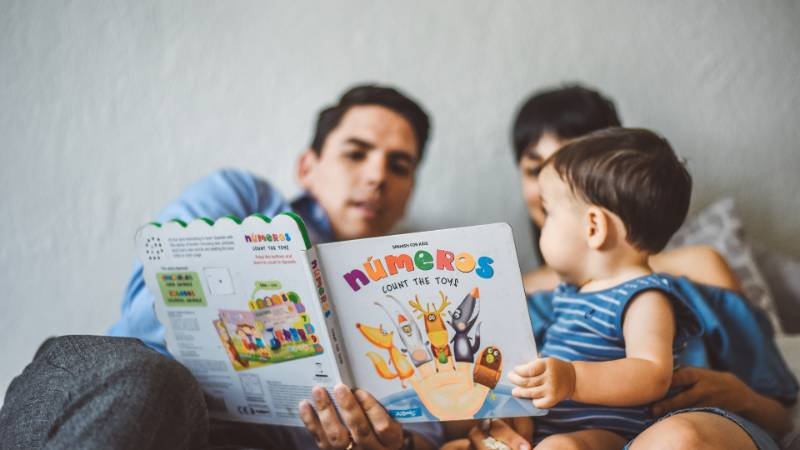
When words fail, images can speak for them.
Many parents tell me:
“Cristina, my son understands, but he can’t express himself.”
And that "doesn't achieve" often contains frustration, both for the child and the adult.
But what we sometimes forget is that communication does not begin with words, but with the intention to be understood.
And that's where stories and pictograms can be powerful allies.
In this article I want to tell you how to use them practically to stimulate comprehension, communicative intent and, little by little, expression in non-verbal children.
1. Pictograms: when the image gives voice
A pictogram is an image that represents a word or action.
Its strength lies in making the invisible visible.
The child does not need to read or speak to understand and anticipate what will happen.
For example: if we show him the pictogram for "bathroom", he understands what's coming.
If we teach him "to eat", he anticipates the action.
And when he sees "playing," he smiles, because he recognizes the routine.
The constant use of pictograms reduces anxiety, improves understanding, and promotes autonomy.
But above all, it teaches something fundamental: communication has meaning.
2. Stories: the power of visual storytelling
Stories are not just entertainment. They are thought structures: beginning, middle, end.
And that sequence helps the brain to organize information and understand cause-and-effect relationships.
When we adapt stories with clear images, simple sentences, and associated gestures, we create a perfect environment for the child to connect words with actions and emotions.
For example:
The character “eats” (verb + pictogram + gesture).
Then he “sleeps” (image + relaxed sound).
Finally, "wake up" (clap, smile, high-pitched sound).
The story thus becomes a multisensory communicative model: the child observes, imitates, anticipates and understands.
3. How to combine them step by step
Integrating stories and pictograms does not require complex materials.
Here's a practical guide:
Choose a short story, with large pictures and few characters.
Identify keywords (actions, objects, emotions) and look for their pictograms.
Show them before you start: “eat”, “run”, “laugh”.
Read it while keeping the rhythm, pointing to the pictograms as you pronounce them.
Invite the child to participate: they can choose the correct pictogram, imitate a gesture, or make a sound.
Reinforce each attempt with a smile, applause, or a song.
In this way, the child not only understands the story, but also learns that he can be a part of it.
4. From understanding to expression
Over time, pictograms become a tool for expressing desires, emotions, or needs.
A child who previously cried for water can now point to the image of "drinking".
Another person might use “stop” to indicate that they need a break.
That change, however small it may seem, transforms everyday life:
Less frustration, more connection, more opportunities for real communication.
And when adults respond to those gestures, the child understands that their voice matters, even if they don't use words.
5. Recommendations for home and school
Place pictograms in visible locations: door, table, bathroom.
Always use the same pictogram for each concept (visual consistency).
Create an “emotions panel” with simple faces and words (“happy”, “sad”, “tired”).
Combine stories with short songs or gestures.
Let the child choose the story: motivation is the best engine of learning.
These small actions create an environment where the child can understand, anticipate, and actively participate.
6. When images pave the way
I have seen children who started by pointing to a pictogram, and months later began to say their first word.
I have seen parents get emotional upon hearing a "mom" that was born from a story shared every night.
Because pictograms and stories do not replace language:
They build it from emotion, gaze, and mutual understanding.
Stories and pictograms are much more than visual tools:
They are bridges between what the child feels and what he or she cannot yet say.
They help to structure thought, calm anxiety, and open the door to communication.
And when we use them with care, rhythm, and consistency, they teach us a profound truth:
All voices deserve to be heard, even those that do not yet use words.
If you want to learn how to integrate the power of image and storytelling into your daily life, join the VICON Method community.
Discover how hundreds of families and professionals are helping their children communicate, step by step, with the help of music, gestures, and stories that come to life.
📲 iOS: https://apps.apple.com/es/app/m%C3%A9todo-vicon/id6479298778
📲 Android: https://play.google.com/store/apps/details?id=com.metodovicon.app