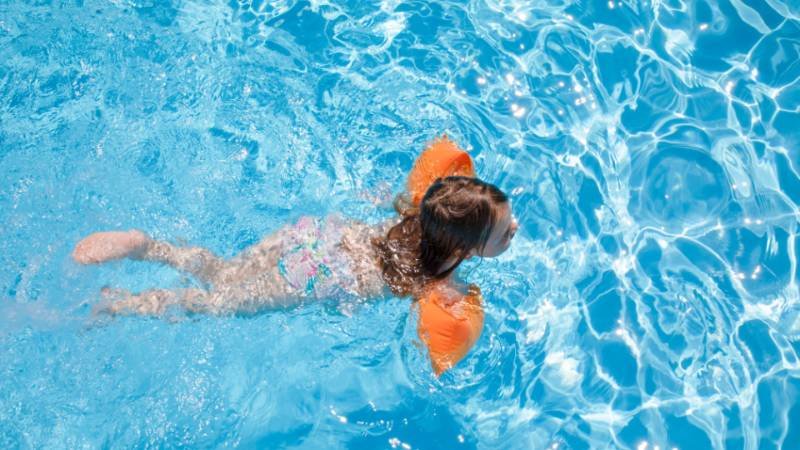
There's something almost every family tells me, and it's true: in the water, many children are transformed. The restless ones calm down. The ones who don't look, look. The ones who resist everything, laugh. The water envelops them, gives them pressure, supports their bodies. It's one of the few places where their nervous system finds peace.
And yet, the water is what scares you the most. Because you know that if she's distracted for even a second, she'll jump in. That she doesn't understand the danger. That she wouldn't call for help.
Both things are true at the same time. And this summer you have to manage them both.
Safety first, because it's non-negotiable.
I'm going to be very direct here, because it matters: children with autism have a particularly high risk of drowning. This is due to two combined reasons: many are intensely drawn to water, and many tend to wander off on their own, without warning, without seeking an adult.
I'm not telling you this to scare you. I'm telling you because almost no summer article mentions it, and there are concrete measures that save lives:
- Assigned, not shared, supervision. "We were all watching" practically means no one was watching. At a family poolside meal, decide who will be on watch, and take turns. Announce each person's name aloud.
- Physical barriers. Pool fencing, high-closing gates, gate alarms if there's water nearby. The barrier isn't distracted; the adult is.
- Adapted swimming lessons. It's not just about learning to swim: it's about learning to float, to turn over, to reach the edge. It's the skill that can protect you the most.
- A vest, not armbands, is only suitable when there are large crowds. And supervision is always required, even if the vest is worn.
- Let them know he's drawn to water. If he gets lost somewhere new, the first thing to look for is the nearest water. Tell whoever is with him.
With that covered, you can now enjoy.
And now, yes: water as a tool
Because once you're safe, water is one of the best learning environments of the year.
- It regulates. The water pressure on the body, the temperature, the slow movement: all of this organizes their nervous system. Many children are more available, more attentive, and more receptive in the water than at any table.
- It evokes language effortlessly. Water naturally sparks a desire to communicate. "More," "again," "jump," "pull," "mine." Functional words that truly serve him, in a context where he feels like using them.
- It allows for anticipation games. And these are pure gold: "Ready... set... GO!" and you throw it. And the next time, you lengthen the pause before the "go" and wait. That wait is an invitation. Many children say their first functional word in a game like this, because they want it to continue.
- The water song. Sing while you play, with rhythm, with repetition, with gaps that he fills in. Music sounds different in the water.
The key: repeat the same structure
What makes a water game teach language isn't the game itself. It's the fact that it's repeated exactly the same way many times, with the same phrase, the same rhythm, the same pause. Predictable repetition is what allows children to anticipate, and anticipation is what allows them to dare to create.
That, precisely, is the logic of the VICON Method: music, rhythm, and structured repetition so that language emerges without pressure. What you do intuitively in the pool, the method systematically reinforces during the other ten minutes of the day, with songs designed by therapists for your child to complete, anticipate, and produce.
👉 Turn every play session into language: start free with the VICON Method for one week → https://www.metodovicon.com/login#registro
Protect him with everything. And then, in the water, let him be the freest child of the summer.