There is something that science has explained many times… but that the heart has always known: music connects.
And when we work with children who have difficulty communicating, that connection becomes a language in itself.
I have seen non-speaking children move their lips to the rhythm of a song.
Others, who avoided eye contact, were made to hold it during a chorus.
I've seen tears, laughter, and even an unexpected "hello" after a drum roll.
It wasn't magic. It was music.
Music doesn't teach: it awakens
When we talk about "musical intervention", many people imagine classes, instruments or scores, but in reality, music is not taught, music is felt.
And it is this vibration, this emotional resonance, that activates parts of the brain related to language, memory, and attention. That is why, in the VICON Method, we don't use songs merely for entertainment, but as bridges to communication.
A melody can order chaos, a pause can calm, a rhythm can guide.
Every sound has an intention: to prepare the body and mind to communicate.
When the body begins to speak. Before words, there is movement, and before movement, there is rhythm.
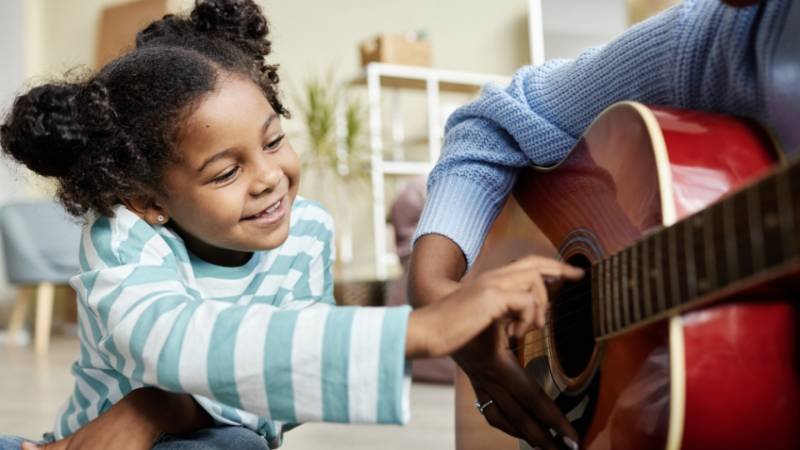
When a child bangs on a table, shakes a maraca, or claps, he is discovering the power of synchronizing with others.
In that synchronicity, joint attention is born, the "you and I are in this together".
That's communication.
No word is needed.
In fact, often the first sign of progress isn't a word, but a gesture: a well-defined "pam," a look, a rhythmic rocking motion. And that response from the adult—that smile that says "I hear you"—is what transforms the experience into learning.
Some parents tell me:
“But I have no ear for music… I sing terribly.” And I always give the same answer:
It doesn't matter. Your child doesn't need a tuned voice, they need a present voice.
When you sing, your breathing regulates, your tone softens, and your body synchronizes with the child's. Language begins to flow not from the throat, but from the connection.
That's why singing while you dress him, while you cook, or while you play can have more impact than a structured session, because the child isn't learning a song. He's learning to communicate with you.
When music becomes home:
There is an instant when everything changes, there is no word, no technical gesture, no planned stimulus, there is only a melody and two hearts beating to the same rhythm.
At that moment, communication ceases to be a goal and becomes a connection. That's when therapy stops feeling like therapy, and life becomes a learning experience.
Music in practice:
Each family can incorporate music in their own way; there's no need for a "perfect plan":
- You can make up songs for the routines: "Time to sleep, time to sleep, the moon wants to hear you..."
- You can set a rhythm with spoons, clapping, or your heartbeat.
- You can move, sway, or laugh while a favorite song plays.
Anything goes, as long as there is a shared gaze, rhythm, and emotion.
Because music doesn't change the child, it changes the way the adult connects with him.
The true transformation:
I have seen families rediscover their children through music.
Professionals who, by allowing room for rhythm and play, found progress that had not come with years of structured repetition.
And children who simply felt understood for the first time.
Music does not replace intervention, it transforms it, it makes it human, sensitive, alive.
And perhaps that's what we most need to remember: that behind every word that has yet to arrive, there is a melody waiting to be heard.
If you've ever felt that words weren't enough, music can be the starting point. At VICON Method, we support families and professionals who want to make learning a more natural, emotional, and connected process.
It's not just about learning to speak, it's about learning to listen again.
📲 Discover more in our community:
iOS: https://apps.apple.com/es/app/m%C3%A9todo-vicon/id6479298778
Android: https://play.google.com/store/apps/details?id=com.metodovicon.app