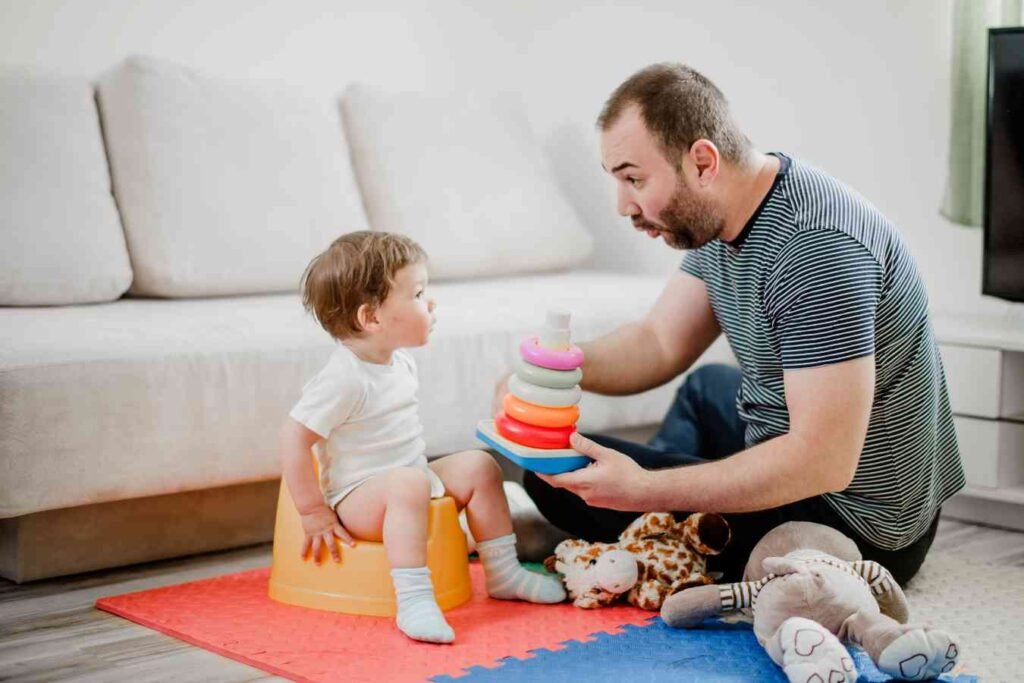
We are going to discuss the topic of "potty training" , that is, training to leave the diaper aimed at non-verbal children with autism spectrum disorders .
Because we know that it is a topic that worries you and often takes up a lot of your time, we are going to review this topic in depth in several blog posts.
In this first part we are going to review the most relevant points, step by step, to leave the diaper in a natural and comfortable way for the little ones . Let's start!
1. GIVING UP NAPPIES
Yes, it's about helping the little one leave ( not removing the diaper ). In fact, I take this opportunity to highlight that it is not about them learning to control themselves as such, but rather that this process is a maturation milestone , just like taking their first steps.
In other words, the child will leave the diaper when he is ready , regardless of the season of the year, when we want him to do it or when it is convenient for us. It has nothing to do with our moment, but with yours.
For different reasons, many parents are forced to start the "diaper operation" in the first summer after their child turns two years old, whether due to social, family or preschool pressure, so that they enter without diapers.
But be careful, you don't have to give in to pressure .
As we know, the maturation and development of children with autism varies from one child to another , and can change a lot in a short time, especially in the first years of life . It is very important to respect their maturation process , so agree with the nursery school and also with your therapists to follow the same line when it comes to removing the diaper.
Our little one should not feel pressured, but rather understood and cared for by the adults around him, which is why the decision to " remove the diaper " must be made consistently, taking into account his moment , not ours.
2. WHEN SHOULD CHILDREN STOP USING NAPPIES?
A typically developing child will stop using nappies between 18 months and 4 years of age. For children with autism, DLD and difficulties with understanding and communication, there are extra challenges… In fact, most autistic children learn to wee and poo on the toilet later than other children.
Every autistic child is unique, there is no doubt about that. Even so, these children often share some common difficulties that can delay or complicate getting ready to stop using nappies.
Knowing these problems will help you think of various ways to meet your child's needs, so let's look at the most common ones:
Language difficulties: Children with autism spectrum disorder often have difficulty understanding and expressing themselves verbally. You should not wait for an autistic child to ask to go to the bathroom, you should learn to understand their needs through non-verbal communication.
3. BLADDER AND BOWEL CONTROL
Before starting this topic, it is necessary to clarify some concepts, such as what sphincters are.
Well, they are those circular or ring-shaped muscles that allow the passage of a substance from one organ to the other through a tube, and are essential for maintaining control over the elimination of waste and other bodily processes.
So when we talk about sphincter control in children , we are referring to the process of helping them learn to voluntarily control the functioning of the anal sphincter (of the bum) responsible for defecation, pooping, and the urethral sphincter , which is responsible for controlling and holding pee or urine.
That said, it is important to be clear that toilet training for autistic children needs an individual approach, adapted to each child’s age and specific needs.
Communication, visual structure, routine and support are key elements in this process.
4. BLADDER AND BOWEL CONTROL IN CHILDREN: WHY MUSCLE TONE MATTERS
Muscle tone seems to be an element far removed from appropriate practices to help a child leave diapers, however it is not. Musculature is a point of great importance that is often overlooked .
In this sense, it is essential to understand the functioning of the bladder muscles. Although it may seem surprising, its function differs from most muscles in the body.
While in other muscles we use pressure to grasp and relaxation to release, in the case of the detrusor musculature involved in bladder control it has to contract to retain pee, and there is my first note, muscle tone is a essential prerequisite for sphincter control .
Low muscle tone can be a factor against the development of these muscles, which, in turn, has an impact on sphincter control.
Therefore, it is of utmost importance to evaluate and consider the muscle tone of our children. In addition, it is advisable to complement it with sports activities that strengthen areas such as the abdominals, glutes and pelvic floor , since these practices can enhance the physiological development of the muscles involved in this process.
5. A RELAXING ENVIRONMENT IS KEY
In another order of ideas, taking into account that, to a large extent, for sphincter control to occur and our child to pee in the toilet it is necessary for him to be relaxed, it is essential that the environment, the bathroom and the toilet become in a space of tranquility, free of fear and stress.
Relaxation is a fundamental factor in making our children feel comfortable when doing their business in the bathroom. Here are some ideas to create a relaxed atmosphere:
Creating a relaxing environment is essential to encourage the necessary relaxation in our children and enable them to use the toilet successfully.
7. GETTING USED TO THE TOILET
Once we have understood the muscular process involved and visualized what our child must do to urinate and retain it, and after having evaluated and strengthened the muscle tone necessary for our muscles to work in our favor in this process, we arrive at the crucial moment. : It's time to start getting used to sitting on the toilet!
The effectiveness of this process depends largely on the comfort of the child. You have to make sure that the little one is sitting comfortably , with a stool for his feet and an adapter that reduces the hole so that he does not have to hold on and put pressure with his little arms to avoid falling through the hole in the toilet, which can generate a state contrary to relaxation.
The first step in this habituation process is to give the receptive instruction "let's go to the bathroom." We take the child's hand and take him to the bathroom, open the lid and sometimes sit him down even when he is dressed. The goal is for the child to get used to sitting in a relaxed and controlled manner for a few seconds.
It is important to remember that when working with non-verbal children or children with communication difficulties, precision in verbal communication is essential . All our verbal communication has to be very precise , that's why we say "let's go to the bathroom" and not "let's pee."
At least it should be like that until we get him to pee for the first time and be able to visually and experimentally understand what a pee is, and thus connect the concept. This precise approach is of great importance and will significantly increase the effectiveness of the learning process .
8. SETTING UP A VISUAL ROUTINE
Visual aids are a great help for children with autism to memorize and understand the process they are about to learn.
For this reason, it is recommended that they have a "photo sequence" that allows them to clearly visualize and understand each step of the process. I give you some examples:
Additionally, it is important to have a visual panel on the mirror or near the sink that reflects each step of the handwashing process:
It is essential to understand that we are teaching an extensive process, but it is very important that our children learn each step individually and progressively. This means that if the child is gradually incorporating the aforementioned habits but still cannot pee, we will stop the learning process at that specific point .
That is, if there is no pee, we will not flush the toilet, we will not wash our hands, and we will not continue with the subsequent steps.
We must focus on the skill we are working on at that moment and move forward step by step.
The child may resist doing the steps at first, as they may associate bathing with different activities, such as showering or washing their hands. Therefore, we must introduce this new routine gradually , first exposing them to familiarization with the toilet, the act of sitting and other new elements that will be incorporated.
9. CHANGING NAPPIES IN THE BATHROOM
Once we have successfully completed the habituation phase , each at our own pace and adjusting each stage according to the individual needs of our child, we can begin to incorporate diaper changing into the bathroom area.
At this point, we have prepared the child and passed the initial habituation phase, in which the child becomes familiar with the process of going to the bathroom, lifting the lid, sitting on the toilet, even with clothes, and is able to wait about three seconds without stress. Now, we are ready to take the next step that will bring us closer to the final goal: pee in the toilet.
Once we have put the child on the stool, we will proceed to remove the diaper and sit him in the bowl, this time without clothes . In this phase, it is essential to begin introducing defined time limits while the child sits and waits. We can use numbers or songs to set a limited time.
The objective of introducing the time limit is to convey to the child that we have not taken him to the bathroom to leave him there indefinitely or until he protests . Gradually, we will lengthen these waiting periods, adapting them to the child's abilities and pace. This may involve adding more numbers to the count or gradually lengthening the wait time .
This strategy will help the child acquire the habit of going to the bathroom calmly and patiently . If the child does not pee during this time, we will pick him up, replace the diaper, and leave the bathroom.
It is not advisable to teach the child to throw the dirty diaper in the trash or to dispose of diaper waste in the toilet at this stage . This is because children can sometimes cling to the diaper as a source of comfort and may resist giving up certain habits. Therefore, we avoid teaching these intermediate steps that could generate unwanted behaviors in the diaper removal process.
10. SETTING REGULAR TIMES
We will establish regular habits , such as peeing when we wake up, before leaving the house, when returning from the street or before going to bed. It is very useful to facilitate the process of toilet training and, finally, giving up diapers.
We must incorporate logical routines so that our child gets used to going to the bathroom in a predictable way at every certain time , which is not three hours but not every 15 minutes.
It is also important to take into account the physiological and organic behavior of our children , both in peeing and pooping. Keeping track of the times when he poops regularly, the times when he drinks the most water and pees the most will help us set more appropriate schedules and achieve success more quickly.
HELP TO MAKE GIVING UP NAPPIES EASIER
If after everything we have said: the space, the objects, the moments, the actions... your child still cannot pee in the toilet, do not be discouraged. We have not yet exhausted all the help you can offer to help him make the transition from diaper to bath .
In this section we are going to review some effective strategies to stimulate the specific moment of peeing, in order to allow a more realistic and graphic experience in the learning process.
Prior to and in parallel with this work, to strengthen awareness of what is happening, we can facilitate the transition to the toilet by using diapers that do not absorb as much , with cloth diapers being an ideal option. This will allow the child to feel the humidity and, on a sensory level, become aware of their need to change due to discomfort .
On the other hand, to facilitate this learning process, make sure to put him in clothes that are easy to put on and take off , such as pants with elastic at the top. Avoid as much as possible jeans, button-down pants, bodysuits and dungarees that are difficult for the child to remove.
Panty diapers are very convenient when you start to grow out of diapers. Furthermore, as in any learning process, it is important to be consistent in routines and know how to wait topromote autonomy .
If we want to prepare him, we can use everything from guided play to stories to show him the functionality of the toilet and what we expect him to do in it . All of this has to be done in advance, nothing in the two weeks prior to running, it's about going at your own pace, not imposing an unnatural pace.
HELP FOR SPECIFIC MOMENTS
Using a glass of water
You will be well aware of the fact that often when we bathe our children, they tend to pee. This usually happens for two main reasons: temperature change and contact with water.
It is a physiological response. Contact with water can influence the relaxation of the body's muscles , we can use this physiological response to our advantage, and this is where the trick of the small glass of water comes in.
To facilitate and stimulate this process, we can use a small glass of warm or lukewarm water and pour it over the child's navel . This small stimulus can help trigger urination more effectively.
Relaxation exercises
Another useful strategy involves performing relaxation exercises while the child is on the toilet . We can use a feather, do breathing exercises, gently tickle or even sing a song...
Now, at this point I would like to make several things clear...
Many parents ask me if tablets can be used right now, and the answer is, yes. As long as it diverts it from the main objective, which is to achieve relaxation. If the child can relax and feel calmer with the help of a tablet, there is no problem in introducing it in this context .
In fact, it can be beneficial to help the child wait patiently and reduce the tension of the moment. This is similar to how many people read or use their mobile devices while in the bathroom.
So far we finish the first article related to the big step of leaving diapers and starting to get into the routine of going to the bathroom for our non-verbal children .
In a few days, you will have the second part.



4 responses
Mi niño autista tiene 11 años..ya iba al baño en el día y por la noche no controlaba … pero ahora empezó nuevamente hacerse en la ropa😪..cómo puedo hacer para que deje ya el pañal de noche y de dia
Mis nenes tienen 10 añitos y aún no dejan por las noches, cómo hago?
Mi es un prematuro extremo que ahora tiene 4 años con dificultades en el neurodesarrollo y trastornos del lenguaje y siempre me pone resistencia para sentarlo en el inodoro, es muy irritable y no he logrado la primer vez que haga en el inodoro
tengo 19,tengo autismo y asperger,yo uso pañal a día de hoy,,hago esteriotipias,camino de un lado a otro,yo tengo una cuidadora que esta conmigo cuando mi mama trabaja ella es bacteriologa,ella esta pendiente de mi ,me baña,me cambia el pañal,ella me lo cambia tres veces al día que es cuando desayuno,almuerzo y me voy a dormir ella me cuida mejor que mi mama ya que ella me lo revisa,cuando salgo con ella lleva la pañalera que ella me lo cambia en el baño de mujeres pero no conmigo sin avisar si no que ella le dice a las del aseo que tiene un adulto con autismo y asperger,que usa pañal y que necesita cambiarmelo entonces cuando uso el baño que salgo ella entra y dentro del baño me hace el cambio mientras que mi mama cuando está conmigo no me lo revisa ,que llego a durar horas con el pañal mojado