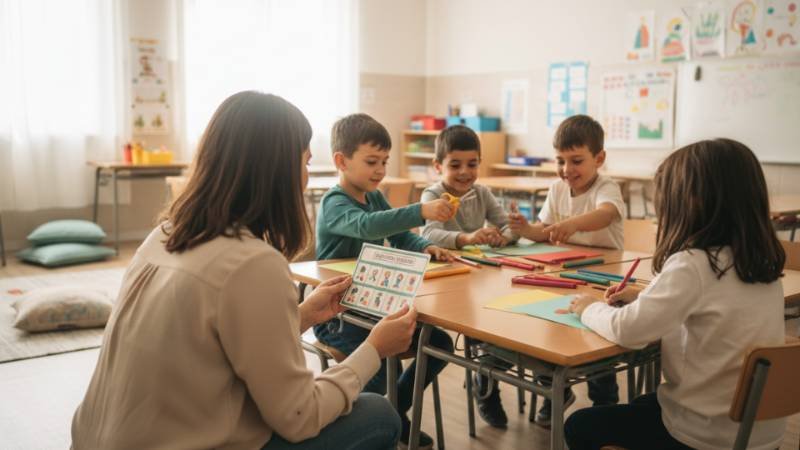
You want your child to be in an inclusive classroom.
But something doesn't add up.
He's in the classroom... and yet he doesn't participate , doesn't learn , or comes out broken .
And then the painful doubt arises: "Is this inclusion or just presence?"
Let me tell you straight: many times the school isn't doing things "badly" out of malice. It's doing them without the right tools .
Here are the 3 most common mistakes I see in school inclusion (ASD and developmental/language difficulties) and, above all, how to correct them with micro-adjustments without starting a war.
Before we begin: inclusion is not "just sitting in the classroom"
True inclusion is not measured by the chair.
It is measured by this:
- Does he participate (even if it's with support)?
- Do you have access to the same activity (adapted if necessary)?
- Is his dignity protected (without exposing him, without isolating him)?
- Does it reduce sensory load and increase comprehension?
If the answer is no, it's not inclusion. It's something else.
Error 1: Disguised segregation (physical presence, real exclusion)
This mistake is very common and often comes with good intentions.
The child is in the classroom, yes.
But:
- at a separate table,
- with another token,
- with another activity,
- with an adult attached as a “shadow”,
- without real interaction with the group.
That's not inclusion.
It is exclusion with physical presence .
Clear signs that it's happening
- He always does different tasks than everyone else.
- She never participates in assemblies, readings, or projects.
- The support becomes a "bubble": it protects him so much that it separates him.
What to do (without confrontation)
He asks for a change of approach:
- Same activity, different access.
- Same overall goal, different entry level.
Examples of real-world adaptation:
- If the group writes 5 sentences, your child can choose between 2 options and paste pictograms.
- If the group reads a text, your child can work on key vocabulary with images.
- If the group is doing a project, your child can have a specific role (distributing, gluing, pointing, choosing).
Useful phrase for tutoring:
- “I don’t want her to do anything else. I want her to do the same thing , with support.”
Error 2: not adapting anything (and calling it “equality”)
“This is what we do in this class. If you can’t do it, you’ll adapt.”
That's not inclusion.
That's neglect .
Equality is not about treating everyone the same.
Inclusion is giving everyone what they need to access .
Micro-adaptations that change everything (and don't break the class)
You don't need a giant plan. You need 3–5 sustained adjustments.
- Visual structure: simple timetable with 4–6 blocks.
- Anticipation: give 2 minutes' notice before a change.
- One-step instructions: one instruction at a time.
- Limited choice: “Do you start with A or B?”
- Pause time: 2–3 minutes to regulate and return.
If the child understands what is happening, the anxiety decreases.
If anxiety decreases, learning increases.
Mistake 3: Not preparing the other children (and then being surprised by the rejection)
Colleagues aren't born knowing everything.
If no one explains it to them, they interpret it.
And when they do perform, sometimes they reject.
True inclusion is also about educating the group .
What does work (and is respectful)
It's not about exposing your child.
It's about normalizing differences.
A simple classroom script (2 minutes):
- “In this class, we all learn differently.”
- “Some brains need more time, more calm, or more visual aid.”
- “If someone covers their ears or needs a break, it’s not unusual. It’s a way of taking care of themselves.”
- “How do we help? With respect, with taking turns, with patience.”
And that's it.
That reduces the mystery.
And when the mystery decreases, the rejection decreases.
How to bring it up in a meeting without getting into a fight with the school
Here's a structure that usually works:
- Start with the common goal
- “I want my son to be well and able to learn.”
- Describe facts, not judgments
- “I’ve noticed that he usually works separately and doesn’t participate in group activities.”
- Ask for specific micro-changes
- “Can we try 2 weeks with: same activity + visual support + anticipation?”
- Agree on how to measure if it works
- "If the crying decreases and participation increases, we're on the right track."
- Close with collaboration
- “At home I can reinforce the routine and key vocabulary.”
Quick checklist: Is this real inclusion?
- My son participates in the same activity (adapted if necessary)
- It has visual supports or structure when needed.
- There is anticipation of changes (transitions)
- It has a possible regulatory pause
- The group understands that we all learn differently.
- He is not isolated “by system”
If 2 or more fail, there is room for improvement.