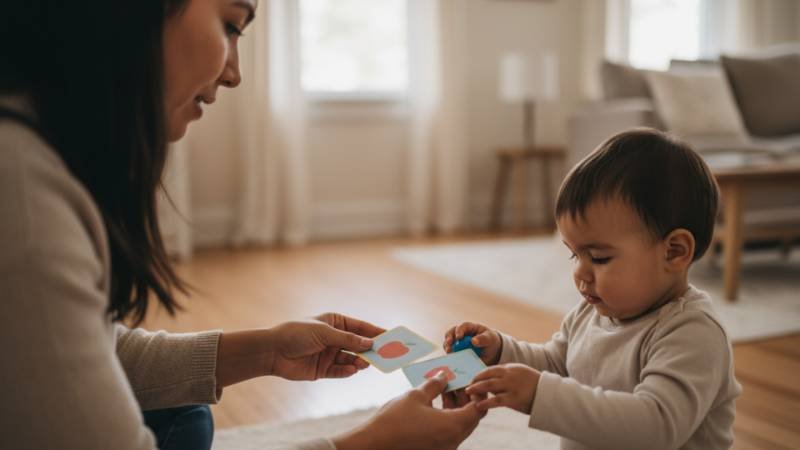
When a child doesn't speak (or speaks very little), the world is filled with hurtful phrases:
- “He’ll talk.”
- “He’s lazy.”
- “Don’t worry, everyone at their own pace.”
And inside you think:
- "What if not?"
- "What if I'm running late?"
Breathe.
You're not exaggerating.
And no, it's not about obsessing over "getting words out." It's about building the foundation so that communication can emerge and be sustained.
Here's a clear guide to get you started.
First: “not speaking” does not mean “not understanding” (but it also doesn’t mean that he understands everything)
A child can:
- to understand much more than what is expressed,
- only understand routines,
- or understand little if the language reaches them too quickly, too long, or without support.
That's why the first objective is not "for him to repeat the grade".
It's about connecting , paying attention , understanding , and having reasons to communicate.
Step 1) Ensure shared attention (without attention there is no language)
Shared attention is that moment when you and your child are "looking at the same thing" and feeling that you are together.
Mini ideas (2–3 minutes, several times a day):
- Get down to their level.
- Use objects that he likes (not those that he “should like”).
- Use dramatic pauses (silence creates opportunity).
- Celebrate the look, the gesture, the approach.
A sign of real progress:
- He looks at you to "share" (not just to ask).
Step 2) Work on imitation (because imitation is the bridge)
Many children with ASD or developmental difficulties have more fragile imitation skills.
And without imitation, language costs twice as much.
Start with motor imitation (easier):
- applaud
- hit table
- head touch
- push car
Then it moves on to imitation with objects:
- put in/take out
- stack
- fit
And only then, vocal imitation:
- simple sounds (mmm, pa, ta)
- onomatopoeias (moo, woof)
Golden rule:
- First, imitate what he does. Then he'll be open to imitating you.
Step 3) Increase comprehension with 1-step instructions
If we give 3 instructions in a row, the child gets lost.
Start with a single action, in a real-world context:
- "Give it to me."
- “Put it on.”
- “Sit down.”
- “Open.”
Aids that work:
- gesture + word
- object in hand
- signage
- visual support (pictograms)
Aim:
- that he understands without you repeating it 10 times .
Step 4) Create communication opportunities (without forcing it)
If everything is provided, the child does not need to communicate.
It's not malice. It's logic.
Create safe “small needs”:
- Just give him a little snack and wait
- put a toy in a box that won't open by itself
- Pause the video/game and wait for a signal.
And when any attempt appears:
- look
- gesture
- sound
- point out
You translate it and turn it into communication:
- "Ah, you want MORE."
- “You want HELP.”
- “You want it AGAIN.”
Step 5) Teach functional communication (even if it's not with words)
This is key and sometimes frees the whole family.
Communication is not just about talking.
It is being able to say:
- further
- No
- aid
- pause
- water
- bathroom
- again
You can start with:
- gestures
- pictograms
- simple signs
- choice between 2 options
The important thing is that the child experiences an impact : "when I communicate, something happens."
Step 6) Coordinate with the school (so that progress is not disrupted)
If you work on communication at home and at school they just "expect him to talk", consistency is lost.
What to ask the school for (simple and specific):
- Step 1 instructions.
- Visual aids (first/then, simple schedule).
- Limited choice (A or B).
- Regulatory pause.
- That reinforce attempts at communication (not just words).
Useful phrase for tutoring:
- “We’re not waiting for perfect words. We’re building functional communication.”
Common mistakes (to avoid them without guilt)
- Repeat “say mom” 50 times.
- Asking questions nonstop (“what is it?” “what is it called?”) when there is no basis yet.
- Give lengthy instructions.
- Do not leave silences.
- Correcting every attempt (kills motivation).
Quick checklist: Where do I start today?
- 5 minutes of shared attention
- 5 minutes of imitation (motor or objects)
- 3 one-step instructions in real-life routine
- 3 communication opportunities (pause/choice/help)
- 1 objective function word (more / help / pause)
Small, sustained, daily.
If you want a step-by-step guide with activities to work on attention, imitation, comprehension and communication (the basis of language), you can try the VICON Method for 7 days free.