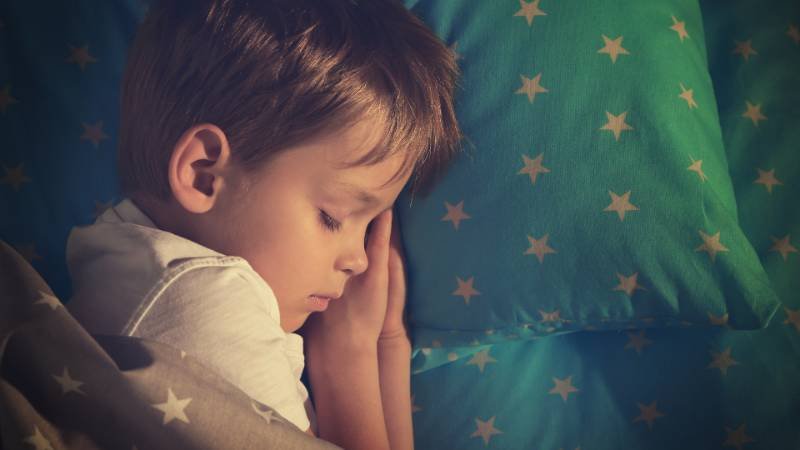
It's eleven o'clock. Outside, you can still hear the neighbors on the terrace. Inside, your son has been pacing for two hours, getting up, asking for water, laughing, crying. And you, who have been holding on all day, feel what little you had left slipping away.
And the thought appears: "If I could at least sleep, I could handle everything else."
I understand. Sleep is the piece that holds everything else together. When it breaks, everything breaks: patience, humor, behavior, language, your ability to enjoy summer. And in summer, it breaks with tremendous ease.
It's not that he's "become spoiled"
In Spain, in July, it's daylight until almost 10 p.m. And light is the signal that tells the brain when to start producing melatonin, the hormone that makes you sleepy. If at 9:30 p.m. the sun is still shining through the window, your child's body simply isn't getting the signal to sleep.
Add to that the heat—which makes it harder to lower body temperature, essential for falling asleep—the long naps after the beach, the late dinners, the unstructured days, and the overstimulation of a full day of stimuli. It's not that he's become capricious or that you've "indulged" him too much. It's that his internal clock has lost its bearings.
And in many children, especially those with autism, that clock was already fragile. Summer doesn't create the problem: it exposes it.
What you can control
You can't change the time the sun sets. You can change almost everything else:
- It gets truly dark. Blinds drawn, blackout curtains, warm, low lights in the last hour. Tricking the light is tricking the clock. It's the most powerful lever you have.
- Cool your body. A lukewarm bath before bed, light cotton clothing, a cool room. Lowering your body temperature is a biological signal that you're ready to sleep.
- Watch your nap time. If you sleep for three hours in the afternoon, the evening is ruined. A short, early nap is better than a marathon afternoon nap.
- Stick to the routine, even if the time changes. This is the important thing: you don't need them to go to sleep at nine o'clock sharp. You need the routine to always be the same. Bath → pajamas → dinner → story or song → light off. The order is what tells the body "time to sleep," more than the clock.
- Turn down stimulation an hour before. No screens, no active games, no visitors. The last hour is for turning down the volume of the world.
The lullaby is not a whim
This is where I want to stop, because it is the most underrated tool that exists.
A song repeated every night—the same one, always—does three things at once. It warns him of what's coming, and the predictability calms him. It regulates his body, because the slow, steady rhythm actually lowers his pulse and breathing, not just metaphorically. And it stimulates his language without anyone else working, in the most intimate and undemanding moment of the day.
You don't need to sing well. It just needs to be the same song, every night, and for him to recognize it from the first note.
When night begins during day
What many families discover is that nights don't get fixed just at night. A child who has spent the day disorganized, overwhelmed, and without any predictable anchor, arrives at bed with their nervous system on high alert. And a body on high alert won't fall asleep no matter how many times you turn off the light.
That's why the groundwork is so important. The VICON Method provides just that: a predictable little bit of time each day, with music, rhythm, and repetition , which helps your child's nervous system regulate itself and allows them to go to bed with less inner turmoil. Ten minutes a day, from your phone, whether you're at the beach, in the countryside, or at home. And for many families, its songs become the missing lullaby.
👉 Help your child regulate their bowel movements this summer: try the VICON Method free for one week → https://www.metodovicon.com/login#registro
An important note: if your child snores loudly, wakes up gasping for air, or has severe and persistent sleep problems, discuss it with their pediatrician. Sometimes there's an underlying, treatable condition, and it's worth ruling it out.
Let the nights return. Everything else weighs less when you sleep.