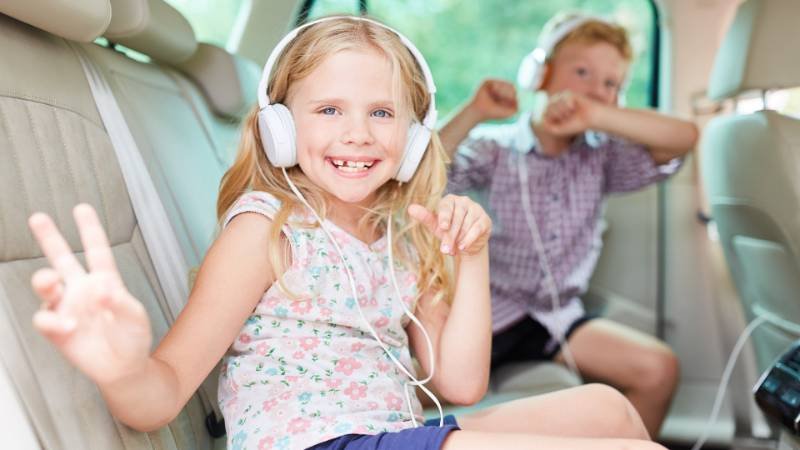
Summer means the open road. Three hours to the village, two to the beach, the rush hour traffic jam. And inside the car, that familiar feeling: "How do I keep him entertained without him being glued to the screen the whole trip?"
I have good news for you. The car, which seems like the worst place in the world for a child who struggles to sit still, is actually one of the best environments for language development . And you don't need to take anything out or prepare anything. You just need to understand why it works.
Why the car is a mine (and not a punishment)
In the car, three things happen at the same time that rarely happen together at home:
- There's no pressure. No one is watching your child, expecting them to "do it right." That lack of pressure is precisely where many children dare to let loose.
- There is rhythm. The clatter, the music, the passing landscape. Rhythm regulates the body and prepares the brain to imitate and repeat.
- You're side by side, not face to face. For many children, especially those with autism, communicating without the pressure of direct eye contact is much easier. The car offers that for free.
Music as a vehicle (never a truer word spoken)
If you follow me, you know that music is at the heart of the VICON Method, and not just by chance. Melody and rhythm activate mirror neurons, direct attention, and transform a difficult word into something you want to repeat. A sung word resonates where a commanded word falls flat.
In the car, that becomes a game:
- Songs with gaps. Play their favorite song and, just before the word they know, lower your voice and pause for a long time. That pause is an invitation. Many children fill in the gap before saying that same word in conversation. Start with the last word of the chorus, which is the easiest.
- Slower is easier. To learn a new song, choose one with a slow tempo. Fast songs are great for those who are already fluent; to start, it's better to go slowly.
- Repeat, repeat, repeat. In the car, repetition isn't boring, it keeps you engaged. Playing that song twenty times isn't tedious: it's good practice.
Language games without materials
When the musical repertoire runs out:
- Auditory "I spy": "Do you hear that? It's a... motorcycle." Listening to and naming the world that passes by.
- Spotting colors and things out the window: "A red truck!", "A cow!". Naming what appears trains vocabulary without anyone noticing that you're "working" on it.
- Sounds before words: If your child isn't speaking yet, imitate the sounds of cars, horns, and water together. Sound is the precursor to words.
No pressure, always
A golden rule: if at any point the game stops being fun, stop. This isn't a cover-up session; it's a nice time that, incidentally, does a lot of good. The goal isn't for me to say a certain number of words before arriving. The goal is for the car to be a place where talking is appealing.
And here's the best part: those songs with gaps, designed with just the right structure for your child to fill in, anticipate, and even try their hand at producing, are already done for you. They're the heart of the VICON Method, designed by therapists precisely so that the music does the work. Carry them on your phone and you'll have a repertoire for the whole trip, with the guarantee that each song is stimulating their language development while they only think they're singing.
👉 Turn every journey this summer into a language: try the VICON Method songs for free for a week → https://www.metodovicon.com/login#registro
Have a good summer and safe travels.