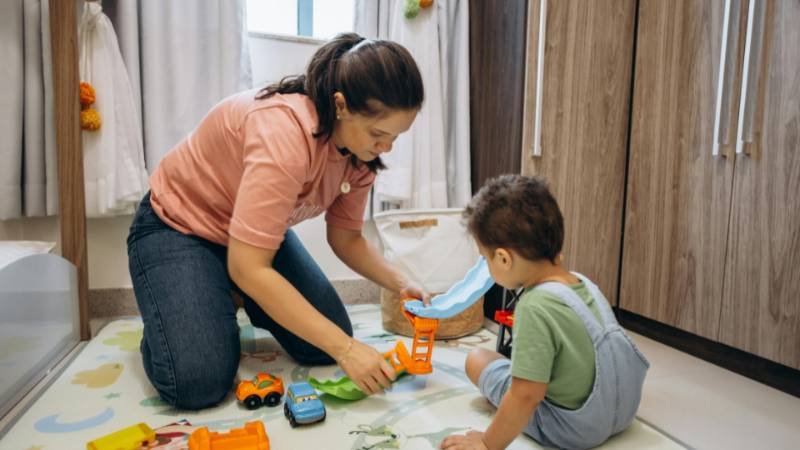
The last day of school has two sides. On the one hand, relief: no more rushing, early mornings, or errands in the planner. On the other, a small panic that isn't always voiced: "And now, two months, all on my own?"
Without school and without therapy sessions, suddenly you're the one holding everything together. And then the trap appears: thinking that to prevent setbacks, you have to compensate by setting up a mini-clinic in the living room. Worksheets in the morning, exercises in the afternoon, "let's work for a little while" ten times a day.
I'm telling you straight because I see it every summer: that approach exhausts everyone and almost never works. Your child doesn't learn better through pressure, and you can't live like you're on vacation inside a therapy session.
Structure is not rigidity
What your child needs in the summer isn't a schedule that's exact to the minute. It's points of reference . It's not the same thing.
Think of three anchors, not a full agenda:
- A consistent wake-up time and a consistent bedtime. Sleep is the foundation. If everything else fluctuates but this remains constant, the body finds its rhythm.
- Meals at roughly the same time. Not the same menu or the same place: the same time slot.
- A small, recognizable daily ritual. Bath time, a story, a naptime song. Something that is repeated and tells them: "the day has a shape."
With those three anchors, the rest can be flexible, improvised, different every day. Security doesn't come from absolute control; it comes from knowing that some things don't fail.
The visual calendar: your best ally in July
One of the most anxiety-inducing things in summer is not knowing what's coming up. A simple visual calendar—with photos or drawings of what's going to happen that day: beach, grandma, nap, park—takes the weight of uncertainty off your child's shoulders. Seeing it allows them to anticipate, and anticipation allows them to feel calm.
It doesn't have to be perfect or beautiful. It just has to be clear and up to standard.
Everyday life is already language (you don't need to "work")
Here's the change that brings the most relief to families: you don't have to make extra time to stimulate language development. You just have to take advantage of the time you already have.
- Set the table together and name what you are taking.
- Singing in the shower that song you know by heart except for the last word… and letting him finish it.
- In the supermarket, search for "the banana", "the milk".
- Describe what you see on the way to the pool.
Ten minutes a day of this, done calmly and without testing, is worth more than an hour of worksheets with your child eager to leave. The key isn't the quantity: it's that it's brief, frequent, and enjoyable.
The "little while" that holds everything together
If you take away just one lesson from here, let it be this: in summer, doing a little often is doing it right. You don't need to prove anything to yourself by sticking to an impossible schedule. Your child doesn't need a therapist at home: they need you, available and calm.
And there's someone who can make that daily "little bit" easy for you. The VICON Method is exactly that: ten minutes a day in the form of games and songs, from your phone or tablet , with the predictable structure your child needs, and without you having to prepare, print, or invent anything. It's the perfect summer language anchor without turning your house into a therapy session and without leaving you exhausted by August.
👉 Let the VICON Method handle that daily time for you: start your free one-week trial → https://www.metodovicon.com/login#registro
A light structure, everyday language, and permission to rest. That's the plan.