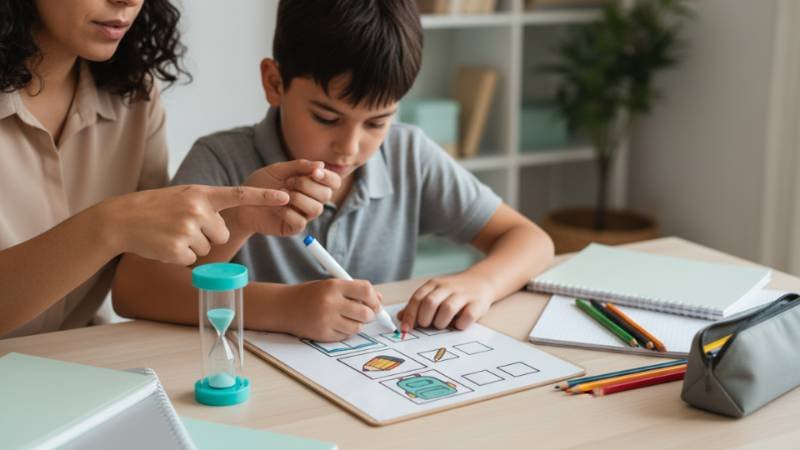
If your child has ADHD (or you suspect they have it), there are days when you feel like you're stuck in a loop:
- You ask him for something and "he doesn't hear you".
- It begins but doesn't end,
- gets frustrated, explodes, or argues,
- And you end up exhausted, feeling guilty, and with the feeling that everything is a fight.
It's not a lack of love.
Often it's a lack of strategy (and an environment that supports their brain).
Here are 7 common mistakes I see at home and at school, and what to do instead to reduce conflict and increase cooperation.
1) Mistake: giving long instructions (and then getting angry because "they don't listen")
In ADHD, working memory becomes saturated quickly.
Instead
- Step 1 instructions.
- Look + gesture + word.
- Ask them to repeat it in a short phrase: "What's next?"
Example:
- Instead of “Go pick up, wash up, put on your pajamas and come to dinner”
- "First pajamas. Then dinner."
2) Error: Repeat 10 times (increasing volume) until it explodes
Repetition doesn't teach. It only increases tension.
Instead
- Say it once.
- 5-second pause.
- Come closer and guide the start (start).
Clue:
- In ADHD, the problem is often not "knowing what to do", but starting .
3) Mistake: punishing deregulation as if it were malicious.
When he's out of control, he's not choosing to "misbehave." He's overwhelmed.
Instead
- Reduce stimuli.
- Few words.
- Brief regulatory pause.
- Then (calmly) you teach an alternative.
Useful phrase:
- “Now we’re back to green. We’ll talk about it later.”
4) Error: asking for self-control without giving it structure
“Focus” is not a tool.
Instead
- Simple visual structure (3 steps).
- Timer.
- Short tasks (5–10 min) + micro-break.
Example:
- 8 minutes task + 2 minutes break + 8 minutes task.
5) Mistake: confusing movement with disrespect
Many children with ADHD regulate their emotions through movement.
Instead
- It allows for "functional movement": squeezing a ball, using an elastic band on a chair, carrying an errand.
- Clear agreements: “You move without bothering others.”
6) Mistake: only reinforcing when “everything is perfect”
If you only validate the result, you lose the progress.
Instead
Strengthen the small things :
- “You started without arguing.”
- “You came back after the break.”
- “You asked for help.”
That builds behavior.
7) Mistake: turning every afternoon into an endless negotiation
When everything is negotiable, the brain looks for the easy way out.
Instead
- Fixed routine (few decisions).
- Limited choice: “Shower now or in 5 minutes?”
- “First/Then” always the same.
7-day mini plan (fast and realistic)
Choose 2 changes and keep them for a week:
- 1 step + gesture instructions.
- Start timer .
- Agreed regulatory pause .
- Micro-progress reinforcement (3 phrases a day).
If you keep it on for 7 days, you'll notice less friction.
If you want step-by-step activities to work on attention, imitation, comprehension and communication (basic skills that greatly help in self-regulation and cooperation), you can try the VICON Method for 7 days free.