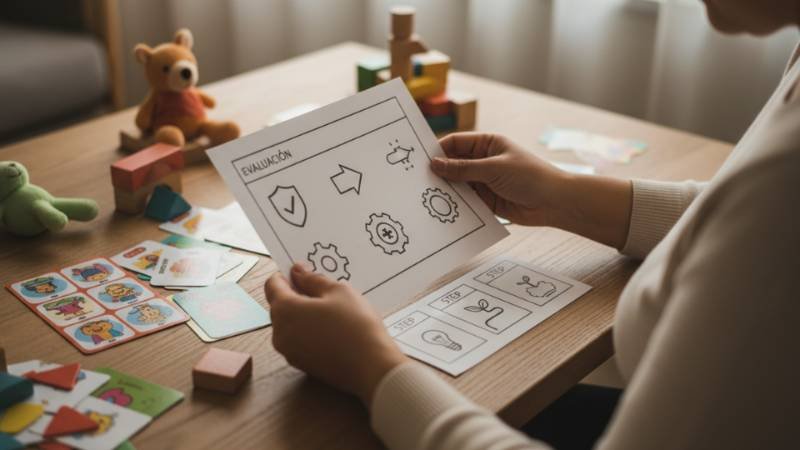
There is a scene that is repeated in many families:
Your child has difficulties with language, communication, attention, or behavior.
You are looking for help.
And you end up with 20 different tips, 10 PDFs, 5 Instagram accounts, and a horrible feeling:
- “I’m doing everything… but I don’t know if I’m doing the right thing.”
That's where a well-planned assessment can change your life.
Not because of "labeling".
But for something much more practical: it gives you a starting point and a plan .
In this article I'll tell you what the VICON Assessment is for , what it offers you and how to use it to make your intervention (at home and coordinated with the school) clearer, more sustainable and with less guilt.
What is (and what is NOT) an evaluation
A useful assessment is not an exam.
It's not "let's see if he can or can't".
It's a snapshot of the present moment to answer 3 questions:
- What skills are already in place?
- What skills are (almost) emerging?
- What basic skill is missing and holding everything else back?
And with that, decide:
- Where to begin?
- what to reinforce,
- and what NOT yet.
What is the VICON Assessment used for (in simple language)
1) To stop working “blindly”
When there is no starting point, it is normal to jump from activity to activity.
The evaluation helps you choose wisely.
2) To prioritize basic skills (the ones that unlock everything)
In many children, before “words”, it is necessary to build:
- shared attention
- imitation
- comprehension (simple instructions)
- motivation and regulation
When those foundations rise, language becomes more possible.
3) To reduce frustration (both yours and the child's)
If the target is above the current level, the following appears:
- frustration
- avoidance
- crying or intense behaviors
Adjusting the level reduces fighting and increases cooperation.
4) To better coordinate with the school and therapists
A family can clearly say:
- “We are now working on X.”
- “We need visual aids.”
- “One-step instructions work.”
That changes the conversation.
What does a communication/language-focused assessment typically measure?
(Without technical jargon, so you can understand.)
- Attention: Can you sustain eye contact/brief activity?
- Imitation: Does he/she imitate movements, actions with objects, sounds?
- Comprehension: Does he/she understand simple instructions in context?
- Communicative intention: Does it ask, show, share, or protest?
- Regulation: what overwhelms it and what calms it?
And, very importantly:
- how he/she learns (with music, with visuals, with repetition, with play, with pauses).
What you get when assessment is used well
- A realistic starting point.
- Specific objectives (not 15 at once).
- An order: first this, then that.
- More calm: because you know what you're doing and why.
How to use the at-home assessment (without becoming a therapist)
1) Choose 1–2 goals per week
Examples:
- increase motor imitation
- improve understanding of 3 instructions
- teach “help” or “pause”
2) Practice a little, but consistently
- 5–10 minutes
- 1–2 times a day
Consistency > intensity.
3) Measure progress with small signs
- more look
- less avoidance
- more attempts
- more calm
That's progress too.
Signs that you're "asking for too much" (and it's time to adjust)
- Behaviors worsen just when you propose the activity
- He leaves, disconnects, or gets angry, always at the same point.
- You end up crying or feeling guilty
Adjusting is not giving up.
Adjusting is intervening intelligently.
If you want to start with a step-by-step route (and activities that work on attention, imitation, comprehension and communication progressively), you can try the VICON Method for 7 days free.